


The Issue
Our Project Eskwela seeks to address the educational crisis in the Philippines that fosters poor literacy and quality of learning (World Bank). Learning poverty, a term referring to the ability to understand and read simple texts by age 10, proves to be prevalent in the Philippines (World Bank). According to the World Bank Report from 2022, learning poverty in the Philippines is significantly higher than the average of East Asia and Pacific regions (World Bank).
Staggering learning poverty is due largely in part to inadequate funding that results in lack of school supplies and texts (Philippine Institute for Development Studies, “Low Education Funding”). Only 3.6% of GDP is spent on education, which is lower than the recommended 4–6% by the United Nations Educational, Scientific and Cultural Organization (UNESCO) (Philippine Institute for Development Studies, “PHL Underspending”). Inadequate funding harms the quality of education and places stress on already limited resources due to staff salaries and special programs (Philippine Institute for Development Studies, “Educational Challenges”).
Our Solution
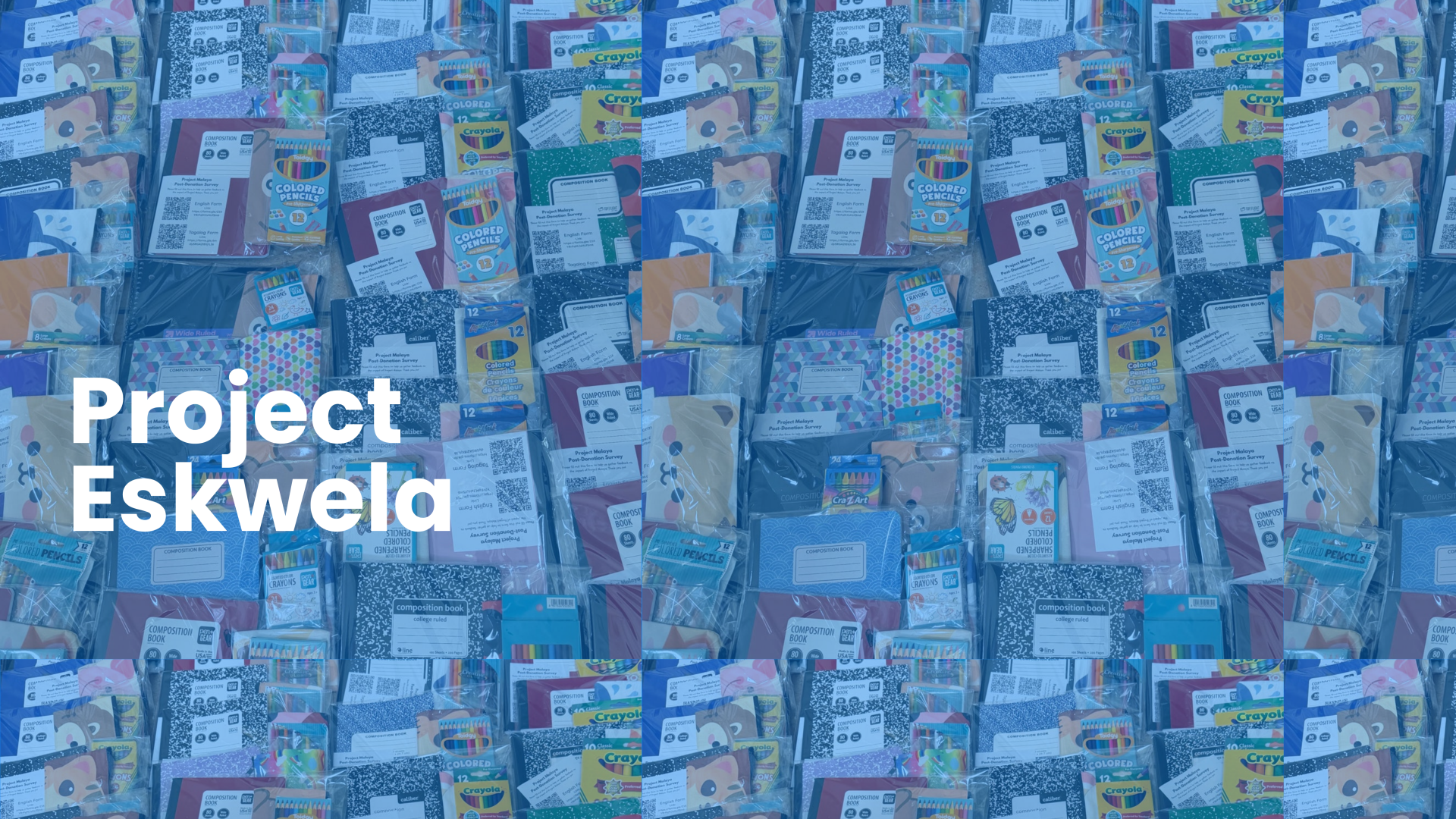
Initiated by Sophia Paray, PHI's Director of Programs and daughter of ANCHS alum, we began Project Eskwela (school in Tagalog) to work towards remediating learning poverty in the Philippines. Project Eskwela targets mainly primary and secondary schools through the donation of books and school supplies such as pencils, pens, paper, and notebooks.
Through book donations, supply drives, bookmark decorating, and more, we hope to improve the resources available to schools and promote interest in reading. By providing adequate resources, we aim to increase the quality of education and literacy. Furthermore, this program also aims to promote interest in reading and writing through a diverse collection of literature and materials to create healthy relationships with learning.
Community Involvement
We rely on organizational collaborations with high school and college students to plan and execute donation drives through their school, student organizations, extracurricular activities, sports teams, and more.
Our PHI members spread the importance of remediating learning poverty to their communities, alongside donation collection efforts. At the end of every semester, volunteers have the opportunity to sort, inventory, and package items into Balikbayan boxes for shipment to the Philippines.



Our Impact
2 elementary & middle school partner facilities
- Alimodian National Comprehensive High School, Iloilo
- Malaya Elementary School, Rizal
1 student-led project
- Project Malaya, Jielianne Rodriguez


Alimodian School Supply Donation Distribution (2026)
References
Philippine Institute for Development Studies. “Educational Challenges in the Philippines.” PIDS, https://pids.gov.ph/details/news/in-the-news/educational-challenges-in-the-philippines
Unknown. “Low Education Funding Underpins Phl Learning Crisis—Study.” PIDS, https://www.pids.gov.ph/details/news/in-the-news/low-education-funding-underpins-phl-learning-crisis-study
Unknown. “PHL Underspending on Education—Study.” PIDS, https://www.pids.gov.ph/details/news/in-the-news/phl-underspending-on-education-study
World Bank. Philippines Learning Poverty Brief. 2022, https://documents1.worldbank.org/curated/en/099000207152223103/pdf/IDU002b5536c0db4104ec3087d809906ec2eae56.pdf